 Shiba inu
Shiba inu Transactions Can Follow Direct ERC-20 or Custodial Routes
Shiba inu transactions can move through a direct Ethereum wallet transfer or a custodial withdrawal. A direct transfer lets the wallet owner review the SHIB contract call, sign the transaction and pay network gas in ETH. A custodial withdrawal begins as a service request, with the custodian controlling preparation and submission of the on-chain transaction. Compare both paths by the required balances, quoted costs, point of commitment and evidence the intended recipient received SHIB.
Last updated:
In short: Compare who signs, how fees are quoted and which records prove completion before choosing a direct SHIB transfer or custodial withdrawal.
Direct transfers and custodial withdrawals
A direct transfer starts with SHIB in a self-custody wallet. The wallet prepares a transaction calling the token contract, the owner signs it and Ethereum processes it. The owner controls the destination, amount and network fee settings exposed by the wallet. This route produces an on-chain transaction hash as soon as the signed transaction is broadcast.
A custodial withdrawal starts with a balance recorded by a service. The customer submits an address and selects an available withdrawal network, but the custodian controls the sending wallet. It may review the request, apply a withdrawal limit or charge and broadcast later. The service may first provide an internal withdrawal ID. After the custodian broadcasts the withdrawal, an Ethereum transaction hash can identify the submitted transaction.
Both routes may finish with the same kind of SHIB Transfer event on Ethereum. Their control models differ before that event exists. A direct sender manages the blockchain transaction, while a custodial customer manages a request whose on-chain execution belongs to the service.
Prerequisites before either route
The standard direct route described here requires the correct SHIB token on Ethereum, enough SHIB for the transfer and enough ETH to pay gas. The wallet must point to the intended network and recipient. Its transaction preview should identify the SHIB token contract rather than sending ETH to the token contract address. Contract identity, recipient identity and network selection deserve separate checks because each describes a different part of the transfer.
The custodial route depends on service availability. SHIB withdrawals must be enabled for the selected network, the available balance must cover the requested amount and any applicable charge and the destination must satisfy the service's address rules. Minimums, limits, authentication steps and temporary withdrawal holds are live service conditions. They should be read from the request screen instead of treated as permanent SHIB properties.
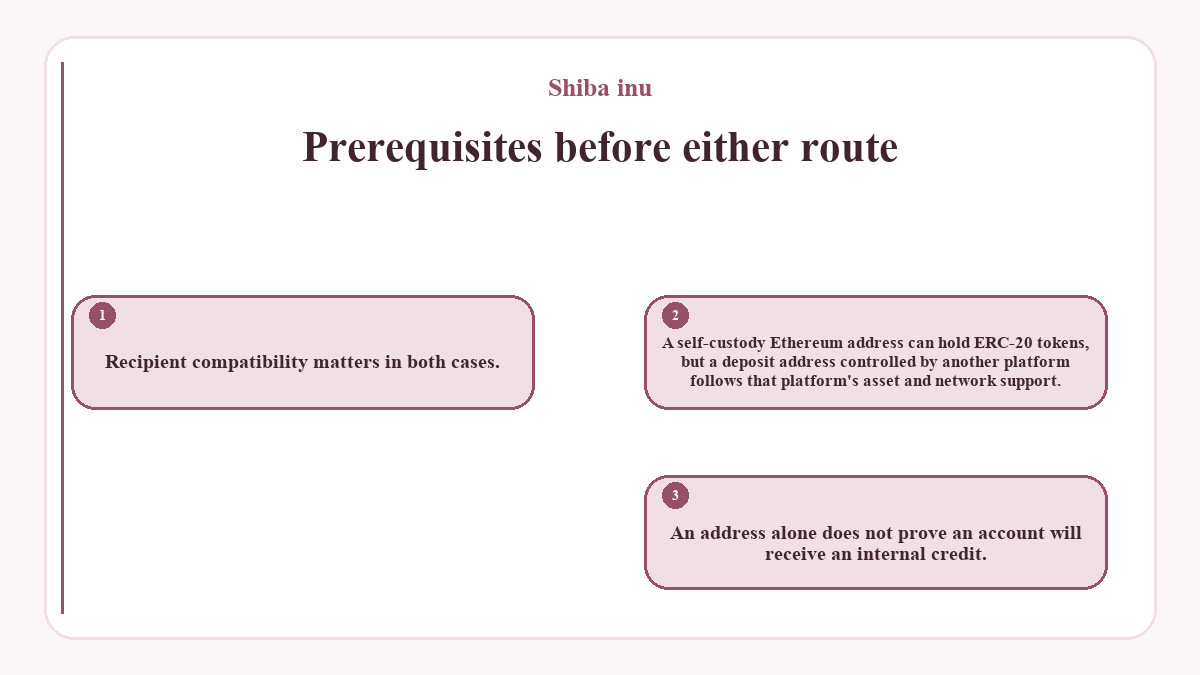
Recipient compatibility matters in both cases. A self-custody Ethereum address can hold ERC-20 tokens, but a deposit address controlled by another platform follows that platform's asset and network support. An address alone does not prove an account will receive an internal credit.
Where does each route become committed?
A direct wallet reaches its commitment boundary when the owner authorizes and broadcasts the transaction. An unsigned preview has no effect on Ethereum. A broadcast transaction may remain pending before inclusion, but its recipient and SHIB amount cannot simply be edited. Changing the attempt requires a separate replacement transaction under the sending account's nonce rules.
A custodial request has a service-defined boundary before blockchain broadcast. Some requests may enter review or processing states in which cancellation is unavailable, even though no transaction hash exists yet. Once the custodian broadcasts an Ethereum transaction, the on-chain sender controls any possible replacement. The customer cannot alter that transaction from a separate wallet.
Confirmation narrows the options further. A successful, confirmed transfer changes the token contract's recorded balances and cannot be reversed through a normal SHIB function. Any return would require the recipient to authorize a new transfer.
One destination, two completion tests
This comparison uses the same intended SHIB amount and Ethereum destination for two possible starting states. In the direct case, the assets begin in a self-custody wallet. The owner checks the token contract, destination and ETH gas quote, then signs. The transaction hash becomes the starting record. Completion requires a successful receipt and a matching Transfer event showing the intended recipient and amount.
In the custodial case, SHIB begins in a service account. The customer compares the quoted withdrawal amount, charge, network and destination before submitting the request. The withdrawal ID proves the service accepted a request, but it does not prove Ethereum execution. After a transaction hash appears, the same receipt and Transfer-event checks can be applied. A completed service status without a usable hash remains service-side evidence.
The decision checklist keeps durable rules separate from values capable of changing between requests:
- Match the Ethereum network, SHIB asset and destination before either commitment point.
- Read gas quotes, withdrawal charges, minimums and service availability as live conditions.
- Identify whether the wallet owner or custodian will sign the on-chain transaction.
- Save the transaction hash or withdrawal ID when it appears.
- Continue only after the receipt, Transfer event and destination record agree.
Treat a direct transfer as complete when its on-chain evidence matches the planned transfer. For a custodial withdrawal, also link the internal request to that evidence so the customer can distinguish the requested withdrawal from another transaction involving the same address.
Costs belong to different layers
A direct Ethereum transfer charges the sending wallet for computation. Its displayed estimate is a live quote, not a fixed SHIB fee. The wallet may show a gas limit, maximum fee settings and an estimated total in ETH. The final network charge depends on the transaction's gas use and the effective gas price when it executes.
Ethereum requires gas to be paid in ETH when a wallet submits a state-changing token contract transaction. The SHIB amount and gas balance are therefore separate inputs. A failed direct transaction can still consume ETH because Ethereum performed computation before recording the failure.
A custodial withdrawal charge belongs to the service's withdrawal process. The service may quote a charge separately or show a net amount after deductions. That charge is not the customer's direct Ethereum gas setting, even when the custodian later pays gas from its sending wallet. A useful comparison records the SHIB expected at the destination, the asset used for any charge and the quote shown at commitment.
Evidence kept by each route
Route evidence should connect the request made before submission with the state recorded afterward. A balance screenshot alone is weak evidence because later activity can change the same balance. Transaction identifiers, receipt status and the relevant token event preserve the relationship more precisely.
Direct transfer record
The direct record begins with the wallet preview and continues with the transaction hash. After execution, the receipt must report success. The SHIB Transfer event should identify the expected token contract, sender, recipient and amount. The destination balance can support that finding, but the event distinguishes this transfer from unrelated balance changes.
Custodial withdrawal record
The custodial record has an internal and an on-chain half. The withdrawal ID, quoted amount, charge, network and destination describe the service request. The later blockchain hash connects that request to Ethereum execution when the service exposes the relationship.
Before broadcast
The internal request may be queued, reviewed, rejected or accepted without any Ethereum transaction. Status labels and cancellation rights vary by service. The absence of a hash means blockchain confirmation cannot yet settle whether the withdrawal will be sent.
After broadcast
The blockchain hash opens a second set of checks. Receipt success establishes whether the transaction executed, while the Transfer event identifies the actual SHIB movement. The on-chain sender may be a custodian-controlled address rather than the customer's account name. That difference is expected under custody and should not be mistaken for a direct wallet transfer.
Can each route be checked with its own Ethereum transaction hash?
Each route can be checked with its own Ethereum transaction hash, but a custodial service must first broadcast its transaction and disclose the hash. A direct wallet normally exposes its hash upon broadcast. A withdrawal ID remains a different identifier and cannot be entered as a substitute for the blockchain hash.
The hash identifies an entire Ethereum transaction, not automatically the one token movement a customer expects. A custodian may use an operational wallet or a contract capable of producing several events. The relevant SHIB Transfer event must still match the intended token contract, destination and amount. Comparing only the transaction's sender and overall success can miss a different token event inside the same execution.
A recipient platform may add another internal stage after successful execution. A successful receipt and matching SHIB Transfer event can prove arrival at its deposit address while the platform's account credit remains pending. That final credit follows the recipient's processing rules rather than Ethereum receipt status.
Durable rules and live conditions
A durable rule describes how the route works regardless of a momentary quote. Direct ERC-20 transfers use a signed Ethereum transaction, change contract state and emit a Transfer event when successful. Custodial withdrawals begin as internal instructions and become independently visible on Ethereum only after broadcast.
Live conditions answer different questions. Gas estimates change with network demand and transaction settings. A custodian can change withdrawal availability, limits, charges, review requirements and confirmation policy. Recording those values at submission preserves the terms applied to that attempt without presenting them as permanent characteristics of SHIB.
A remembered withdrawal charge should not be compared with a fresh gas quote, and an old minimum should not be treated as a token rule. The two routes should be evaluated from quotes shown for the same intended action at the same decision point.
Route-specific stop states
An internal rejection stops a custodial request before Ethereum execution. Without a blockchain hash, changing gas settings or searching for a receipt cannot resolve it. The request record should identify whether the address, available balance, network selection or a service restriction blocked submission.
A pending direct transaction belongs to the signing account's nonce sequence. Its signer may have replacement options supported by the wallet and Ethereum client rules. A custodial customer does not control the provider's nonce or fee settings, so a pending withdrawal must remain tied to the provider's transaction record.
A failed Ethereum receipt means the intended state change did not complete. The direct sender may still pay gas. A custodian's treatment of its failed outgoing transaction depends on its internal process, so the withdrawal balance and status must be reconciled before another request is submitted.
A successful receipt with the wrong SHIB recipient or amount is not the intended completion state. Blockchain success only says the recorded transaction executed. It does not validate the address chosen before signing. Repeating the action without resolving that mismatch can create a second transfer instead of correcting the first.
Choosing by control and proof
The better route follows the starting custody and the control the sender needs. A direct transfer suits SHIB already held in a wallet when the owner wants to set the destination, authorize the contract call and inspect immediate on-chain evidence. It also requires ETH for gas and responsibility for every transaction field.
A custodial withdrawal suits SHIB held in a service account when its supported network, charge, limits and timing are acceptable. The service handles the sending wallet, but the customer gives up control over broadcast timing and fee settings. Across destination, cost, commitment and completion, a direct transfer provides transaction control, while a custodial withdrawal relies on service rules and adds an internal record.
Common questions about Shiba inu
-
Which record confirms a custodial SHIB withdrawal became an on-chain transaction?
- An Ethereum transaction hash identifies the custodian's submitted transaction, but a receipt for that hash confirms on-chain inclusion. The service's withdrawal ID only identifies its internal request. Use the hash to inspect receipt status and the matching SHIB Transfer event, then connect those results back to the quoted amount, network and destination saved with the withdrawal record.
-
Can the Ethereum sender differ from the account owner who requested the withdrawal?
- Yes. A custodial customer authorizes a withdrawal through a service account, while the custodian controls the wallet or contract used to send SHIB on-chain. The on-chain sender may therefore have no visible resemblance to the customer's account. Match the destination, SHIB contract, amount and linked withdrawal record instead of expecting the customer to appear as the blockchain sender.
-
Is ETH required in both SHIB transfer paths?
- A standard direct SHIB transfer on Ethereum requires the sending wallet to hold ETH for gas. A custodial customer does not control the custodian's sending wallet or pay its gas directly. The service may instead quote a withdrawal charge under its own rules, so the asset used for the charge and the net amount must be read from the request.
-
Does a lower quoted withdrawal charge guarantee more SHIB reaches the destination?
- No. Compare the net SHIB amount shown for the recipient, not the charge label alone. A direct transfer normally sends the specified SHIB amount while charging gas separately in ETH. A custodian may display its charge and delivered amount differently. Network selection, minimums and any receiving-platform credit rules can also determine whether the quoted transfer is usable.
-
Could an Ethereum address accept ETH yet fail to support a SHIB deposit?
- Yes, when the address belongs to a custodial platform with asset-specific deposit rules. Technical control of an Ethereum address does not guarantee the platform will credit every ERC-20 token sent to it. The receiving account must support SHIB on the selected network and satisfy any deposit requirements shown for that account before either transfer route is committed.